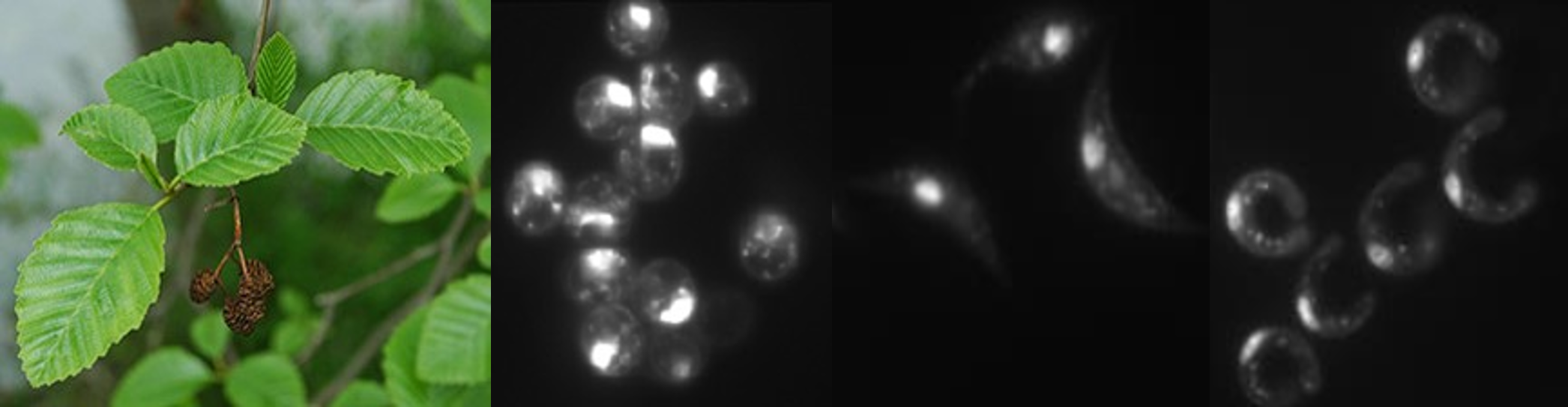
Our group leverages empirical and omics-based approaches to elucidate when and how biological diversity at multiple scales regulates organismal and ecosystem functions. Most biodiversity research focuses on the species-scale dimension. In contrast, my lab considers biological variation within a species. We probe how variation within species alters plant-microbe interactions and has larger scale effects on ecological communities and ecosystems. We study three aspects of individual variation: phenotype, genotype, and variation imparted by host-associated microbes. We focus on variation within species of algae and riparian plants that regulate key components of the carbon cycle – primary productivity and decomposition, in aquatic ecosystems. We also study elements of intraspecific variation within Microcystis aeruginosa, the species responsible for most freshwater harmful algal blooms, which cause human illness and wildlife mortalities.
Beyond our basic and applied research in aquatic community ecology, a second core research direction of our lab is the development of single-celled phytoplankton as a model microbial system for understanding the eukaryotic host microbiome. Like most free-living organisms on the planet, even single-celled eukaryotes have microbiomes that are replete with bacteria. Further, the diversity of these phytoplankton hosts span ~2.7 billion years of evolutionary divergence across both eukaryotic and prokaryotic domains of life, yet all can be grown under identical conditions. We therefore leverage this unparalleled phylogenetic breadth of phytoplankton with controlled experiments to probe the roles of the host genotype and phenotype in driving microbiome assembly and function. We further aim to use this tractable experimental system to unravel the host regulatory factors that drive succession and evolutionary change within the microbiome. By growing hundreds of generations of extremely large population sizes of microbial hosts in the lab, we aim to generate insights that are unattainable from even ‘experimentally tractable’ multi-cellular host models. Ultimately, we anticipate that the conclusions from our work can provide broad insights about these complex microbial systems that are known to impact many aspects of both human and environmental health.